What Makes the Google Pixel 8 Worth Buying?
The Google Pixel 8 marks a significant milestone in smartphone longevity with its groundbreaking 7-year software update commitment. Released in October 2023, this device redefines what users should expect from long-term smartphone investments. Google promises major Android upgrades through 2030, meaning this phone will receive Android 21 when most 2023 devices have long been abandoned. This extended support transforms the Pixel 8 from a simple purchase into a genuine long-term companion.
The Tensor G3 chipset represents Google’s third-generation custom silicon, built on advanced 4nm architecture. This processor excels at AI-driven tasks like real-time translation, voice transcription, and computational photography. While raw benchmark scores might not match Snapdragon’s top offerings, the Tensor G3 delivers where it counts for everyday users. The chip handles multitasking smoothly, runs demanding apps without stuttering, and powers Google’s exclusive AI features that simply aren’t available on other devices.
Photography remains the Pixel’s strongest suit, and the Pixel 8 continues this tradition brilliantly. The 50MP main sensor with optical image stabilization captures stunning detail in various lighting conditions. Google’s computational magic transforms ordinary snapshots into extraordinary images. Night Sight produces remarkably bright photos in near-darkness, while features like Best Take ensure group photos where everyone looks their best. The 12MP ultrawide camera offers creative flexibility for landscapes and architecture shots.
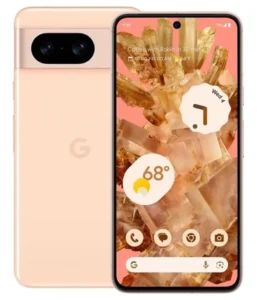
Build quality feels genuinely premium. Gorilla Glass Victus protects both front and back surfaces, while the aluminum frame adds structural integrity. At 187 grams, the phone feels substantial without being heavy. The compact 6.2-inch form factor suits users who find modern phablets unwieldy. The device slips easily into pockets and can be operated comfortably with one hand, something increasingly rare in today’s smartphone landscape.
Things to Know Before Choosing the Google Pixel 8
Storage options remain limited to 128GB and 256GB, with no expandable storage via microSD cards. Users who download large games, store extensive photo libraries, or save lots of offline content need to carefully consider which capacity suits their needs. The 128GB model might feel restrictive for power users, especially given the phone’s 7-year lifespan. Choosing 256GB upfront provides more breathing room, though it increases the initial investment.
The 4575mAh battery capacity sits below many competitors offering 5000mAh or larger cells. While Google’s software optimization helps stretch battery life, heavy users might find themselves reaching for a charger by late afternoon. Those who stream videos for hours, use GPS navigation extensively, or play graphics-intensive games should temper their expectations. The phone handles moderate daily use comfortably, but it’s not the endurance champion some users might want.
Charging speeds, while improved over previous Pixels, still lag behind competitors. The 27W wired charging takes over an hour for a full charge, compared to some phones offering 65W or even 120W charging that can fully charge in 30 minutes. The 18W wireless charging performs well for overnight charging but won’t save users in a time crunch. Those accustomed to ultra-fast charging might need to adjust their habits.
The camera system lacks a telephoto lens, relying instead on digital zoom for distant subjects. While Google’s Super Res Zoom produces impressive results for digital zoom, it can’t match the quality of true optical zoom found on the Pixel 8 Pro or competing flagships. Photography enthusiasts who frequently shoot wildlife, sports, or other distant subjects might miss this capability. The phone compensates with exceptional image processing, but hardware limitations remain.
Is the Google Pixel 8 Right for You?
Long-term planners who want a phone that stays current for many years will find the Pixel 8 perfect. The 7-year update commitment means buying this phone today provides security and features through 2030. This longevity makes the device ideal for environmentally conscious users who want to reduce electronic waste or budget-minded buyers who plan to maximize their investment. Students entering college can reasonably expect this phone to serve them through graduation and beyond.
Photography enthusiasts seeking the best computational photography available should seriously consider the Pixel 8. Google’s camera software remains industry-leading, producing consistently excellent photos that often surpass phones with more impressive hardware specs. Features like Magic Eraser, Photo Unblur, and Real Tone make photo editing accessible to everyone. The camera excels in challenging conditions where other phones struggle, particularly in low light or high-contrast scenes.
Compact phone lovers tired of increasingly large devices will appreciate the 6.2-inch display. This size offers an excellent balance between screen real estate and pocketability. The 120Hz OLED panel delivers smooth animations and vibrant colors in a form factor that remains comfortable for one-handed use. The phone measures just 150.5mm tall, making it noticeably more compact than most modern flagships while still providing an immersive viewing experience.
Casual users who prioritize reliability over raw performance will find the Pixel 8 delivers exactly what they need. The clean Android experience, free from bloatware and manufacturer skins, provides a smooth, predictable interface. Call screening helps filter spam calls, while features like Live Translate break down language barriers. The phone handles everyday tasks like browsing, social media, messaging, and video streaming effortlessly.
Mobile gamers seeking maximum performance might want to explore alternatives. While the Tensor G3 handles most games competently, it doesn’t deliver the same frame rates as Snapdragon 8 Gen 3 or Apple’s A17 Pro chips in the most demanding titles. The phone gets warm during extended gaming sessions, and the 8GB of RAM, while adequate, doesn’t match the 12GB or 16GB found in dedicated gaming phones. Casual gamers won’t notice limitations, but enthusiasts might.
Best Alternatives to the Google Pixel 8
The iPhone 15 presents Apple’s answer for users who prefer iOS over Android. It offers comparable build quality, excellent cameras, and Apple’s legendary software support. The iPhone’s A16 Bionic chip delivers superior gaming performance, and the integration with other Apple devices remains unmatched. However, the Pixel 8’s 7-year update commitment exceeds even Apple’s support timeline, and Google’s computational photography still edges out Apple in certain scenarios, particularly night photography.
The Samsung Galaxy S24 competes directly with more powerful hardware, including the Snapdragon 8 Gen 3 processor and a versatile triple-camera system with telephoto capabilities. Samsung matches Google’s 7-year update promise while offering features like DeX mode and S Pen support on certain models. The Galaxy S24’s faster charging and larger battery appeal to power users. However, Samsung’s One UI adds complexity that some users find overwhelming compared to Pixel’s clean Android experience.
OnePlus 12 delivers flagship performance at a more competitive price point. It features a larger battery, significantly faster 100W charging, and a powerful Snapdragon 8 Gen 3 processor. The camera system, co-developed with Hasselblad, produces excellent results. Users prioritizing raw performance and battery life will appreciate these advantages. The trade-off involves accepting shorter software support (4 years versus Pixel’s 7) and less refined computational photography.
The Google Pixel 8 Pro offers a compelling upgrade path for users who want to stay within the Pixel ecosystem. The Pro model adds a telephoto camera with 5x optical zoom, a larger 6.7-inch display with higher peak brightness, and 12GB of RAM. Both phones share the same Tensor G3 processor and 7-year update commitment. The decision comes down to whether the additional camera capabilities and larger screen justify the higher price tag.
Google Pixel 8 Frequently Asked Questions
How many years of software updates does the Pixel 8 receive?
The Google Pixel 8 receives an unprecedented 7 major Android upgrades, starting from Android 14. This means the device will be supported through Android 21, with security updates extending well into 2030. This industry-leading commitment makes the Pixel 8 one of the longest-supported smartphones available, ensuring the device remains secure and feature-rich for years to come.
Does the Pixel 8 support wireless charging?
Yes, the Pixel 8 supports 18W wireless charging, which is significantly faster than many competitors. The device also features reverse wireless charging, allowing users to charge other Qi-compatible devices like wireless earbuds or smartwatches by placing them on the back of the phone. The 27W wired charging can reach 50% battery in just 30 minutes.
Is the Pixel 8 good for photography?
The Pixel 8 excels at photography with its 50MP main camera featuring optical image stabilization and a 12MP ultrawide lens. Google’s computational photography, powered by the Tensor G3 chip, delivers exceptional results across all lighting conditions. Features like Best Take (which ensures everyone looks their best in group photos), Magic Eraser, and Ultra HDR make it easy to capture professional-quality images. The camera can record 4K video at 60fps with both gyro-EIS and OIS stabilization, producing smooth, stable footage.
What is the difference between Pixel 8 and Pixel 8 Pro?
The Pixel 8 features a 6.2-inch display versus the Pixel 8 Pro’s 6.7-inch screen. The Pro model includes an additional telephoto camera with 5x optical zoom, a temperature sensor, and faster 30W wired charging. The Pixel 8 Pro also has 12GB of RAM compared to the Pixel 8’s 8GB. However, both phones share the same Tensor G3 processor, receive the same 7 years of software updates, and deliver similarly excellent computational photography. The Pixel 8 offers better value for users who don’t need the larger screen or telephoto camera.
How is the Pixel 8 battery life?
The Pixel 8’s 4575mAh battery provides solid all-day performance for most users. With typical usage including browsing, social media, messaging, and moderate camera use, the phone easily lasts a full day. The efficient Tensor G3 processor and adaptive battery features help optimize power consumption. Heavy users who stream videos extensively or play games for hours may need a top-up by evening. The 27W fast charging and bypass charging feature (which prevents battery degradation during gaming) help maintain battery health over the device’s long lifespan.