
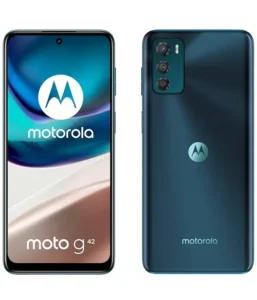
What Makes the Motorola Moto G42 Worth Buying?
The Motorola Moto G42 stands out in the budget segment by incorporating an AMOLED display, a premium feature typically reserved for pricier devices. This display technology delivers vibrant colors, deep blacks, and superior contrast ratios compared to standard IPS LCD panels found on most competitors. The 6.4-inch screen with 1080 x 2400 pixel resolution produces sharp imagery at 411 ppi, making text crisp and photos detailed. AMOLED panels consume less power when displaying darker content, potentially extending battery life during everyday use.
Audio quality receives significant attention with dual stereo speakers that create a more immersive sound experience. Whether watching YouTube videos, streaming Netflix shows, or playing mobile games, the stereo configuration delivers fuller, more balanced audio compared to single-speaker setups. The inclusion of a 3.5mm headphone jack provides flexibility for users who prefer wired audio connections, an increasingly rare feature as manufacturers shift toward wireless-only designs.
The lightweight construction at just 175 grams makes the G42 comfortable for extended holding periods. This feather-light build reduces hand fatigue during long reading sessions, extended video calls, or marathon gaming sessions. The slim 8mm profile slides easily into pockets and bags without creating bulk. Despite the lightweight design, Motorola includes water-repellent coating that protects against accidental splashes and light rain exposure.
Photography capabilities center around a 50MP primary sensor with PDAF for quick focusing. The high-resolution main camera captures detailed images in favorable lighting conditions, while the 8MP ultrawide lens expands creative possibilities for landscape shots and group photos. The 16MP front camera delivers sharp selfies and handles video calls with clarity. NFC support enables contactless payments through Google Pay and other mobile wallet services, adding convenience for everyday transactions.
Motorola delivers a clean software experience with Android 12 and promises an upgrade to Android 13. The near-stock Android interface minimizes bloatware and unnecessary customization, ensuring smooth operation and intuitive navigation. The Snapdragon 680 4G chipset built on a 6nm process balances performance with power efficiency, handling everyday tasks competently while maintaining reasonable battery consumption from the 5000mAh cell.
Things to Know Before Choosing the Motorola Moto G42
The absence of 5G connectivity represents the most significant limitation for forward-looking buyers. The Snapdragon 680 4G restricts the device to GSM, HSPA, and LTE networks, lacking access to next-generation 5G speeds. As 5G infrastructure expands globally, this limitation increasingly affects long-term device relevance. Users planning to keep the phone for multiple years or living in areas with robust 5G coverage should carefully weigh this constraint against the phone’s other benefits.
Charging speed disappoints at just 18W, particularly when competing devices in similar price ranges offer 30W or faster charging solutions. The 5000mAh battery takes approximately 2.5 to 3 hours to fully charge from empty, requiring extended planning for charging sessions. Users cannot quickly recover battery life during short breaks, making overnight charging essentially mandatory. This slower charging speed becomes increasingly inconvenient for heavy users who need rapid power replenishment throughout busy days.
Gaming performance faces limitations with the Adreno 610 GPU. While the processor handles casual titles smoothly, demanding games like Genshin Impact, Call of Duty Mobile, or PUBG Mobile at high settings produce inconsistent frame rates and noticeable performance drops. Gamers must significantly reduce graphics quality to achieve acceptable performance, and even then, expect frame rate fluctuations during intense gameplay moments. The phone serves casual gaming adequately but disappoints users expecting smooth experiences in popular demanding titles.
Video recording capabilities remain basic, maxing out at 1080p resolution at 30 frames per second for both rear and front cameras. The lack of 4K recording limits content creation potential, especially as 4K capture becomes standard even in budget devices. Without electronic or optical image stabilization, handheld video footage appears shaky unless users maintain exceptionally steady hands or invest in external stabilization accessories. Content creators producing videos for social media platforms face quality constraints compared to competitors offering 4K recording.
Low-light photography reveals the camera’s budget origins. The 50MP sensor performs admirably in bright conditions but struggles significantly as lighting diminishes. Nighttime shots show excessive noise, reduced detail, and poor color accuracy. The absence of dedicated night mode or advanced computational photography means users cannot rely on the G42 for evening photography or indoor shots without substantial artificial lighting. The 2MP macro lens provides minimal practical value beyond occasional close-up shots with limited detail.
RAM configurations max out at 4GB across all storage variants, potentially limiting multitasking capabilities for power users. Heavy multitaskers running numerous apps simultaneously may experience slowdowns and app reloads as the system struggles to keep everything in memory. The plastic build, while contributing to the lightweight design, feels less premium than glass or metal alternatives. Long-term software support remains uncertain, with Motorola typically providing limited major Android updates beyond the promised Android 13 upgrade for budget devices.
Is the Motorola Moto G42 Right for You?
Media consumption enthusiasts who prioritize display and audio quality find exceptional value in the G42. The AMOLED screen transforms video streaming experiences with vibrant colors and true blacks that IPS LCD panels cannot match. Binge-watching Netflix series, streaming YouTube content, or scrolling through Instagram becomes more visually engaging. The stereo speakers complement the display quality, creating an immersive entertainment package without requiring headphones. Users who frequently consume content on their phones appreciate this combination of premium display technology and enhanced audio at an accessible price point.
Budget-conscious buyers seeking premium features without flagship prices discover the G42 hits a compelling sweet spot. The AMOLED display typically found on devices costing significantly more provides immediate visual gratification. The lightweight 175-gram design appeals to users who value comfort during extended phone use, whether reading ebooks, browsing social media, or handling extended video calls. The clean Android experience attracts users who prefer simplicity over heavily customized interfaces laden with bloatware.
Students and young professionals balancing tight budgets with functionality needs benefit from the G42’s balanced approach. The phone handles productivity apps like Google Workspace, email, web browsing, and video conferencing without significant performance issues. The dedicated microSDXC slot allows storage expansion for documents, presentations, and media files without sacrificing dual SIM capability. NFC support enables contactless payments on campus or at coffee shops, adding convenience for cashless transactions.
Casual photographers shooting primarily in daylight conditions will appreciate the 50MP camera’s detail capture. The sensor produces social media-ready images suitable for Instagram posts, Facebook sharing, or personal documentation. The ultrawide lens adds compositional flexibility for landscape photography or fitting larger groups into frame. However, users should maintain realistic expectations about low-light performance and understand the camera’s limitations in challenging conditions.
The G42 disappoints several user groups. Serious mobile gamers need devices with more powerful processors and GPUs, as the Snapdragon 680 and Adreno 610 cannot deliver smooth performance in demanding titles even at reduced graphics settings. Content creators requiring 4K video recording or advanced stabilization must look elsewhere, as the 1080p-only capture limits production quality. Users prioritizing 5G connectivity for future-proofing should avoid this device entirely. Photography enthusiasts requiring consistent quality across various lighting conditions won’t find the G42’s camera adequate for their needs. Power users who heavily multitask with numerous resource-intensive apps simultaneously will find the 4GB RAM insufficient. Anyone demanding fast charging capabilities should explore alternatives offering 30W or faster charging speeds.
Best Alternatives to the Motorola Moto G42
The Samsung Galaxy A23 4G offers similar specifications with enhanced features in several areas. Samsung includes a larger 5000mAh battery paired with 25W fast charging that significantly reduces charging times compared to the G42’s 18W solution. The device features a 6.6-inch display with comparable resolution, though it uses PLS LCD technology rather than AMOLED. Samsung’s One UI provides more features than stock Android, and the company guarantees three years of Android version updates plus four years of security patches, substantially outlasting Motorola’s typical update commitment. The Snapdragon 680 processor matches the G42’s performance, making them equally capable for everyday tasks.
Xiaomi Redmi Note 11 delivers superior display technology with a 6.43-inch AMOLED panel featuring 90Hz refresh rate, surpassing the G42’s standard 60Hz AMOLED screen. The 90Hz refresh rate adds smoothness to scrolling and animations that the G42 cannot match. Xiaomi includes 33W fast charging that dramatically reduces charging times, fully replenishing the 5000mAh battery in approximately 90 minutes. The Snapdragon 680 processor matches the G42’s capabilities. However, MIUI adds considerable bloatware and advertisements that clutter the user experience compared to Motorola’s clean Android interface, potentially frustrating users seeking simplicity.
Realme 9i provides 5G connectivity through the MediaTek Dimensity 810 chipset, addressing the G42’s most significant limitation. This future-proofing advantage makes the 9i more appealing for buyers in regions with expanding 5G networks. Realme includes a 5000mAh battery with 18W charging matching the G42’s speed. However, the device uses an IPS LCD display rather than AMOLED, sacrificing the G42’s superior display technology for future network compatibility. Realme UI includes more bloatware than Motorola’s near-stock approach, though some users appreciate the additional customization options.
Nokia G60 5G emphasizes longevity through Android One certification, guaranteeing three years of monthly security updates and two major Android version upgrades. This exceptional software support significantly outlasts typical budget device commitments. Nokia includes 5G connectivity through the Snapdragon 695 chipset, providing future network compatibility the G42 lacks. The device features a 4905mAh battery with 20W charging, slightly faster than the G42’s 18W solution. However, Nokia uses an IPS LCD display rather than AMOLED, sacrificing visual quality for improved software support and 5G capability. The commitment to sustainable materials and repairability appeals to environmentally conscious buyers.
Poco M4 Pro 4G targets users seeking maximum performance in the budget segment. The device includes a 6.43-inch AMOLED display with 90Hz refresh rate, combining the G42’s display technology with enhanced smoothness. Poco features the MediaTek Helio G96 processor, delivering noticeably better gaming performance than the Snapdragon 680. The 5000mAh battery supports 33W fast charging that dramatically reduces charging times. However, Poco’s MIUI-based interface includes substantial bloatware, advertisements, and aggressive notifications that significantly diminish the user experience compared to Motorola’s clean software approach. Users must weigh enhanced specifications against increased software clutter.
Motorola Moto G42 Frequently Asked Questions
What makes AMOLED displays better than LCD screens?
AMOLED displays produce superior image quality compared to IPS LCD screens through fundamentally different technology. Each pixel in an AMOLED panel emits its own light, allowing individual pixels to turn completely off when displaying black content. This creates true blacks with infinite contrast ratios, whereas LCD screens backlight all pixels continuously, producing grayish blacks. Colors appear more vibrant and saturated on AMOLED displays, with wider color gamuts that make photos and videos more visually striking.
AMOLED technology consumes less power when displaying darker content since pixels turn off individually, potentially extending battery life when using dark themes or watching content with black bars. The viewing angles remain consistent on AMOLED panels without color shifting or brightness degradation visible on many LCD screens when viewed from angles. Response times prove faster on AMOLED displays, reducing motion blur during fast-moving content like sports or action sequences. However, AMOLED screens can experience burn-in with static elements displayed for extended periods, and they typically cost more to manufacture than LCD panels.
Does the Moto G42 support 5G networks?
The Motorola Moto G42 does not support 5G connectivity. The device operates exclusively on GSM, HSPA, and LTE networks through the Qualcomm Snapdragon 680 4G chipset, which lacks an integrated 5G modem. This limitation keeps manufacturing costs down but restricts future network compatibility as 5G infrastructure expands globally.
Users in regions with widespread 5G coverage or those planning to keep the device for three or more years should carefully consider whether this limitation affects their usage needs. While 4G LTE networks remain robust and will continue functioning for many years, the absence of 5G may impact long-term device relevance, resale value, and the ability to take advantage of faster network speeds as they become more prevalent. Buyers prioritizing 5G connectivity should explore alternative devices with next-generation network support, though this typically requires accepting compromises in other specifications like display technology or increasing budget allocation.
How long does the 5000mAh battery last on typical usage?
The 5000mAh battery delivers solid all-day endurance for moderate usage patterns. Light users who primarily text, check email, browse social media, and make occasional calls easily achieve 1.5 to 2 full days between charges. The AMOLED display’s power efficiency when showing darker content helps extend battery life, particularly for users who enable dark mode across their apps. Moderate users engaging in several hours of screen-on time through video streaming, web browsing, social media scrolling, and photography typically complete a full day with 20-30% battery remaining.
The efficient Snapdragon 680 4G chipset built on 6nm process technology helps maximize battery longevity through reduced power consumption during everyday tasks. Heavy users pushing the phone with constant screen time, gaming, intensive camera use, and continuous connectivity should expect a full day of usage before requiring overnight charging. However, the 18W charging speed means full recharges take 2.5 to 3 hours, making quick top-ups during short breaks impractical compared to devices with 30W or faster charging capabilities.
Can the Moto G42 handle mobile gaming?
The Moto G42 handles casual mobile games smoothly but struggles with demanding titles. The Snapdragon 680 4G processor with Adreno 610 GPU runs lightweight games like Candy Crush, Subway Surfers, Among Us, Temple Run, and similar casual titles at maximum settings without performance issues. Mid-tier games like Mobile Legends, Arena of Valor, and Asphalt 9 perform acceptably at medium graphics settings, delivering playable frame rates around 30-40 fps. However, graphically intensive games like Genshin Impact, Call of Duty Mobile at high settings, or PUBG Mobile at ultra settings face significant performance challenges with frequent frame rate drops, stuttering during intense action sequences, and longer loading times. Players must reduce graphics quality to low settings and accept 30fps performance rather than smooth 60fps gameplay.
The Adreno 610 GPU represents entry-level graphics processing that cannot compete with mid-range gaming-focused chipsets. The AMOLED display enhances the gaming experience with vibrant colors and deep blacks, but the processor cannot generate enough frames to fully utilize the display’s potential in demanding games. Serious mobile gamers seeking smooth high-setting performance should consider devices with Snapdragon 695, MediaTek Helio G96, or better processors specifically optimized for gaming workloads.
What camera quality can users expect from the 50MP sensor?
The 50MP primary camera delivers impressive results in optimal lighting conditions. Bright outdoor daylight photography produces detailed images with accurate colors, good dynamic range, and sufficient sharpness for social media sharing and personal documentation. The PDAF autofocus system locks onto subjects quickly, minimizing blurry photos caused by slow focusing. The high resolution allows for significant cropping while maintaining acceptable detail levels, useful for reframing shots or zooming into distant subjects.
The 8MP ultrawide camera adds compositional versatility for landscape photography, architectural shots, and group photos requiring wider fields of view, though image quality noticeably decreases compared to the main sensor with reduced sharpness and increased distortion at frame edges. Indoor photography with adequate artificial lighting produces acceptable results, though sharpness and color accuracy diminish compared to outdoor shots.
The camera’s performance deteriorates dramatically in low-light and nighttime conditions, producing grainy images with excessive noise, poor detail retention, and inaccurate colors. The lack of dedicated night mode, optical image stabilization, or advanced computational photography severely limits evening and indoor photography capabilities. The 16MP front camera captures decent selfies in good lighting and handles video calls adequately, though quality drops substantially in dim conditions. Video recording maxes out at 1080p 30fps without stabilization, resulting in shaky footage unless users maintain steady hands throughout recording. The 2MP macro camera provides minimal practical value beyond occasional extreme close-up shots with limited detail and usefulness.