
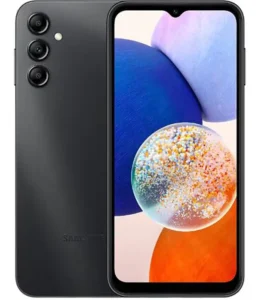
What Makes the Samsung Galaxy A14 Worth Buying?
Released in March 2023, the Samsung Galaxy A14 makes a strong case for being one of the most capable budget phones Samsung has produced in the sub-mid-range tier. A 50MP primary camera, a full 1080p LCD display, a 5000mAh battery, and Android 13 with confirmed upgrades through Android 15 — that’s a spec sheet that competes well above what the A14’s price implies, and it’s backed by Samsung’s software reliability and brand support infrastructure.
The 6.6-inch PLS LCD display at 1080 × 2408 pixels (~400 ppi) is one of the A14’s more quietly impressive features. Full HD resolution across a large panel at this price point is genuinely uncommon — most budget phones at the A14’s tier settle for 720p. At 400 ppi, text is sharp, images render with real detail, and the 20:9 aspect ratio creates a tall, comfortable canvas for scrolling and video consumption. It’s an LCD, not AMOLED, so the blacks and contrast won’t rival Samsung’s own A34 or A54 — but for everyday use, the display quality is well above budget expectations.
The camera setup covers meaningful ground for a phone at this price:
- 50MP wide lens (f/1.8, PDAF, 1/2.75″): The headline shooter with phase-detection autofocus and a bright f/1.8 aperture — a wide lens opening that allows more light in compared to f/2.0 and f/2.2 competitors at the same tier. PDAF ensures fast, accurate focusing on subjects.
- 5MP ultrawide (f/2.2, 17mm, 1/5.0″): A wide-angle lens for group shots, interior spaces, and scenes where the standard lens can’t fit the full picture without stepping back.
- 2MP macro lens: Close-up photography for food, flowers, and fine surface textures.
- 13MP front camera (f/2.0, 1/3.1″): A capable selfie shooter with a bright f/2.0 aperture and a decent sensor size for this price tier — handles video calls and social media portraits reliably.
Battery life is a consistent strength. The 5000mAh Li-Po cell powers the A14 through a full day of mixed use without requiring a mid-afternoon charge hunt. The efficient chipsets — Helio G80 or Exynos 850, depending on the regional version — keep power draw conservative, extending that endurance further than the raw capacity alone might suggest. The 15W wired charging is adequate, though not fast by current standards.
The software picture is genuinely encouraging for a budget phone. The A14 launched on Android 13 and is upgradable to Android 15 with One UI 7 — two major OS versions from launch. That’s a solid update commitment for this price class, and combined with Samsung’s reputation for delivering security patches consistently, it means the A14 stays protected and current longer than most budget alternatives. The side-mounted fingerprint sensor is quick and naturally placed for everyday unlock. USB Type-C 2.0 with OTG, dual-band Wi-Fi 802.11 a/b/g/n/ac, a dedicated microSDXC slot, and the 3.5mm headphone jack all add practical daily value.
Things to Know Before Choosing the Samsung Galaxy A14
The Galaxy A14 is a good phone for its price, but being clear about its real-world limitations helps set accurate expectations. The chipset varies by regional version — the Helio G80 (Version A) and Exynos 850 (Version B) are both entry-level to lower-mid-range processors. Daily tasks run fine: messaging, streaming, social media, and light multitasking don’t cause problems. Demanding 3D games, extended multitasking with many apps open, or tasks that push processing headroom will hit the chip’s ceiling faster than on a more powerful mid-range device. Performance is reliable within its class, but it’s not a performance phone.
The display, while full HD at 400 ppi, is a PLS LCD — contrast and black depth are visibly lower than AMOLED panels, and outdoor brightness can feel limited compared to higher-nit competitors. For media enthusiasts who watch a lot of video or care deeply about display quality, the difference between this LCD and Samsung’s own AMOLED mid-rangers is noticeable. It’s not a bad display — far from it — but the trade-off is real.
Several other points deserve honest attention before buying:
- No 5G connectivity: The A14 is an LTE-only device — GSM, HSPA, and LTE are the network ceiling. Samsung does produce a Galaxy A14 5G variant separately, but the standard version covered here does not support 5G.
- 15W charging speed: The 5000mAh battery takes a while to fill at 15W. Faster competitors at similar prices now offer 25W or 33W charging. It’s workable overnight, but not convenient for a quick top-up before heading out.
- Video capped at 1080p@30fps: Neither the front nor rear cameras support 4K recording. For video content creators, this is a meaningful limitation.
- No IP water resistance rating: The A14 carries no official dust or water resistance certification. Casual rain exposure is likely survivable, but submersion and prolonged moisture contact carry risk.
- No gyroscope sensor: The confirmed sensor list includes a fingerprint reader, accelerometer, proximity sensor, and compass — but no gyroscope. This limits AR apps, 360-degree video, and some motion-based games.
- Chipset varies by region: Buyers in different markets may receive either the Helio G80 or Exynos 850 version. The Helio G80 has a slight gaming performance edge; the Exynos 850 operates on a more efficient 8nm process. Performance differences are minor in everyday use, but worth knowing.
- NFC is market-dependent: Not all regional A14 variants include NFC. Buyers who want tap-to-pay should verify their specific market model before purchasing.
Is the Samsung Galaxy A14 Right for You?
The A14 is a compelling choice for a specific kind of buyer, and knowing that profile helps make the decision straightforward.
Budget buyers who refuse to sacrifice display resolution will find the A14 unusually satisfying. Getting a full 1080p screen — something many phones at this price tier skip — at 400 ppi is a genuine quality differentiator. Reading, browsing, and watching standard content all look meaningfully sharper than on 720p alternatives, and that sharpness shows up every time the phone is picked up.
First-time Android users and switchers from older phones will appreciate Samsung’s well-organized One UI 7 interface and the reliability that comes with a major brand’s support ecosystem. Software updates through Android 15 mean the phone stays current for a meaningful period, and Samsung’s familiarity lowers the learning curve for users coming from older Samsung devices or basic feature phones.
Students and light daily users who need calls, messaging, social media, navigation, and occasional photography covered without spending much will find the A14 hits every essential mark. The 5000mAh battery handles full school or work days comfortably, the side fingerprint sensor is fast and reliable for quick unlocks between classes or meetings, and the 50MP main camera produces social-media-ready photos in good lighting.
Parents buying a first smartphone for teenagers get a phone that’s capable enough to keep up with modern apps without overspending. The lack of 5G and modest gaming performance are actually neutral for this use case — the A14 handles everything a teen needs day-to-day without the premium cost that gaming-focused or 5G-capable alternatives carry.
The A14 is not the right fit for mobile gamers who want smooth frame rates, video creators who need 4K recording, users in areas where 5G is the primary network, or anyone planning to use dual SIM and expanded storage simultaneously — the dedicated microSDXC slot is a positive, though users should confirm whether their variant supports full dual SIM with the expansion slot in their configuration.
Best Alternatives to the Samsung Galaxy A14
The budget Android segment in 2023 and beyond is genuinely competitive, and the A14 has some noteworthy rivals worth comparing.
The Samsung Galaxy A14 5G is the most natural alternative for buyers in 5G markets. It runs a different chipset — the Dimensity 700 — and adds 5G connectivity while keeping the same general design language and price accessibility. If 5G is a priority now or in the near future, the 5G variant is worth the small additional cost.
The Samsung Galaxy A24 steps up meaningfully within Samsung’s lineup — bringing a Super AMOLED display, a better chipset, and a more complete feature set. For buyers who can stretch the budget slightly, the AMOLED display difference alone is substantial and worth the consideration.
The Xiaomi Redmi Note 12 competed at a similar price point with a 120Hz AMOLED display, a 50MP main camera, and 33W fast charging — a faster charging speed than the A14’s 15W that makes a real practical difference. For buyers who prioritize display quality and charging convenience, it’s a strong comparison.
The Motorola Moto G54 offers 5G connectivity, a 120Hz LCD display, and a 50MP main camera at an entry-level price — another relevant comparison for buyers who want 5G without stepping too far outside the budget.
Samsung Galaxy A14 Frequently Asked Questions
Does the Samsung Galaxy A14 support 5G?
No, the standard Samsung Galaxy A14 does not support 5G — it operates on GSM, HSPA, and LTE networks. Samsung produces a separate Galaxy A14 5G model with a different chipset and 5G capability, but that is a distinct device. The standard A14 covered here is an LTE-only phone. Buyers in markets where 5G is actively expanding and want future-proof network access should consider the A14 5G variant or a 5G-capable alternative.
What Android version does the Galaxy A14 support, and will it get more updates?
The Samsung Galaxy A14 launched on Android 13 and is upgradable to Android 15 with One UI 7. Android 15 represents the confirmed upgrade ceiling for this model. That’s two major Android version upgrades from launch — a reasonable software lifespan for a budget device, and better than many competing phones at this price that offer only one OS update. Samsung also delivers ongoing security patches, keeping the phone protected even after major OS updates conclude.
Is the Galaxy A14 camera good for everyday photography?
For everyday use in good to moderate lighting, the Galaxy A14 camera performs well above its price point. The 50MP main sensor with PDAF and an f/1.8 aperture captures detailed, well-focused shots for social media, family moments, and product photos. The f/1.8 aperture is notably wide for a budget phone — it gathers more light than the f/2.0 and f/2.2 lenses common at this tier, helping in indoor environments. The 5MP ultrawide adds creative flexibility. Low-light results are acceptable but limited. Video is capped at 1080p at 30fps on both cameras — there is no 4K recording on the A14. The 13MP selfie camera with f/2.0 aperture handles video calls and portraits confidently.
How long does the Galaxy A14 battery last?
The 5000mAh Li-Po battery is one of the A14’s strongest daily-use advantages. For typical mixed use — calls, messaging, social media, occasional video streaming, and navigation — the A14 reliably lasts a full day and often has charge remaining at bedtime. Lighter users can stretch it toward a day and a half without difficulty. The 15W wired charging gets the battery refilled overnight without issue, but it’s not a fast-charging device — buyers who want a quick 30-minute top-up before heading out should compare phones with 25W or faster charging.
Does the Galaxy A14 have a headphone jack?
Yes, the Samsung Galaxy A14 includes a 3.5mm headphone jack. This is increasingly uncommon even among budget and mid-range phones — Samsung’s own higher-tier A-series models like the A34 have dropped the headphone jack — making the A14’s inclusion a practical advantage for buyers who use wired headphones daily. The 3.5mm jack works alongside USB Type-C 2.0 with OTG support, giving the A14 both wired audio options without requiring an adapter.