
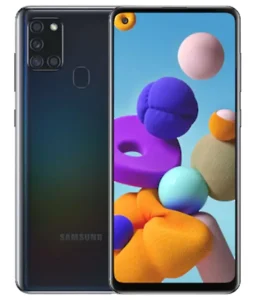
What Makes the Samsung Galaxy A21s Worth Buying?
The Samsung Galaxy A21s launched in mid-2020 as a budget device that genuinely over-delivered for its price. A 48MP quad-camera array, a 5000mAh battery, the Exynos 850 chipset built on an 8nm process, and a spacious 6.5-inch display came together in a package that offered more than most buyers expected at the entry level. For first-time smartphone owners, upgrade seekers from older devices, or budget-conscious buyers wanting a recognizable brand, the A21s made a compelling case.
Battery life is the headline feature. The 5000mAh Li-Po cell is the kind of capacity that most users won’t drain in a single day — even with moderate screen time, social media, and calls, the A21s routinely makes it through the day with charge to spare. That endurance gives users a genuine sense of reliability without constantly hunting for a charger. The 15W wired charging tops it back up in a reasonable time, though it’s not a fast-charging device by current standards.
The camera setup is more capable than what entry-level phones typically offer:
- 48MP wide lens (f/2.0, PDAF, 1/2.0″): The primary shooter with phase-detection autofocus and a decently sized 1/2.0″ sensor — capable of sharp, detailed images in good lighting with fast subject locking.
- 8MP ultrawide (f/2.2, 123°, 1/4.0″): A genuine wide-angle option that fits more into a frame — useful for group shots, travel photography, or interior spaces.
- 2MP macro lens: Close-up capability for food, textures, and small objects.
- 13MP front camera (f/2.2, 1/3.1″): A solid selfie shooter with a respectable sensor size for video calls and social sharing.
The Exynos 850 chipset on an 8nm process is a notable upgrade over the older 14nm and 12nm chips that populates much of the budget tier. That process improvement translates to better power efficiency — the chip handles everyday tasks, messaging apps, and light multitasking without draining the battery at an aggressive rate. RAM options reach up to 6GB, and storage configurations extend to 128GB, giving buyers meaningful flexibility. The dedicated microSDXC slot makes further expansion easy.
Connectivity is comprehensive for the price. Wi-Fi 802.11 a/b/g/n/ac with dual-band support, Bluetooth 5.0, GPS with GLONASS, GALILEO, and BDS, FM radio with RDS and recording, and USB Type-C 2.0 all feature on a spec sheet that covers daily practical needs. The 3.5mm headphone jack is present — a straightforward decision that budget buyers universally appreciate. NFC support, where available by region, adds contactless payment capability. A rear-mounted fingerprint sensor provides quick, reliable biometric access.
The sensor suite is also more complete than expected at this tier — an accelerometer, gyroscope, proximity sensor, and compass give the A21s compatibility with a wider range of apps and use cases than many budget alternatives that omit the gyroscope.
Things to Know Before Choosing the Samsung Galaxy A21s
The A21s earns its place in the budget segment, but a few limitations need honest consideration before buying. The display is the most significant trade-off. A PLS LCD panel at 720 × 1600 pixels across 6.5 inches lands around 270 ppi — functional for everyday use but noticeably less sharp and vivid than the AMOLED panels found in slightly higher-priced Samsung models. Colors are decent, but contrast, black levels, and outdoor visibility don’t match what AMOLED technology delivers. For media-heavy users, this is a meaningful distinction.
Performance has a clear ceiling. The Exynos 850 handles daily communication, social apps, and light use competently, but demanding tasks — heavy multitasking, graphically intense mobile games, or extended video editing — will push the chip’s limits. The eMMC 5.1 storage is also slower than the UFS variants found in mid-range devices, which subtly affects app load times and file operations. The 2GB RAM configurations in particular should be avoided; the 4GB or 6GB options deliver a noticeably smoother day-to-day experience.
Several other limitations are worth flagging:
- No 5G support: The A21s is strictly a GSM, HSPA, and LTE device. In markets where 5G is actively expanding, this limits the phone’s long-term relevance.
- Android 12 is the final major OS update: The A21s launched on Android 10 and reached Android 12 with One UI 4.1 — that’s the software ceiling. No Android 13 or beyond is expected.
- No IP rating: Water resistance is not certified on the A21s. Rain splashes are likely manageable in practice, but submersion or prolonged moisture exposure isn’t covered.
- Plastic back and frame: The rear and frame are plastic. Practical for durability against drops, but the build doesn’t feel premium compared to glass-back alternatives.
- NFC is market-dependent: Not every regional variant includes NFC. Buyers who want tap-to-pay should verify their specific market before purchasing.
- Video limited to 1080p@30fps: Neither the front nor the rear cameras record 4K — a trade-off that’s acceptable at this price point but worth knowing for video-focused buyers.
Is the Samsung Galaxy A21s Right for You?
The Galaxy A21s was built for a specific buyer — and it serves that person well. The question is whether that profile matches the intended use case.
First-time smartphone buyers and older users stepping into Android for the first time will find the A21s approachable. Samsung’s One UI is well-organized and intuitive, the large 6.5-inch screen is easy to read, and the rear-mounted fingerprint sensor is straightforward to use. The long battery life removes one of the most common anxieties for new smartphone users.
Budget-conscious secondary device buyers get a reliable backup or travel phone without a significant financial commitment. The dual SIM support is practical for separating personal and work contacts, and the dedicated microSDXC slot means storage isn’t a constant concern. The comprehensive sensor suite — including gyroscope and compass — ensures the A21s works with a wide range of apps that cheaper phones sometimes can’t support.
Casual photographers and social media users who want more camera flexibility than a single-lens budget phone provides will appreciate the 48MP main sensor and ultrawide lens. The PDAF autofocus keeps subject locking quick for candid moments, and the 13MP front camera handles selfies and video calls competently. Content expectations should be calibrated to good-lighting scenarios — this isn’t a low-light specialist.
The A21s is a harder sell for mobile gamers, video creators who need 4K recording, power users who multitask heavily, or anyone planning to hold the phone for more than two to three years given the Android 12 update ceiling. For those needs, a current budget or entry-level mid-range device with more recent software support is the smarter investment.
Best Alternatives to the Samsung Galaxy A21s
The budget Android market has strong competition around the A21s’s tier, and a few alternatives deserve consideration depending on priorities.
The Samsung Galaxy A22 is the natural successor and upgrades the experience noticeably — bringing a 90Hz display, a more capable chipset, and Android 12 out of the box. For buyers who can access the A22 at a comparable price point, it’s the more forward-looking choice.
The Samsung Galaxy A32 steps up to a Super AMOLED display, a faster processor, and better camera performance for buyers who can stretch the budget. The display quality difference alone between the A21s’s PLS LCD and the A32’s AMOLED is striking enough to justify the price gap for many users.
The Xiaomi Redmi 10 competed directly in the A21s’s price range, offering a 90Hz display and faster UFS 2.2 storage — two specifications where it outpaces the A21s for buyers who prioritize screen smoothness and storage speed.
The Motorola Moto G Power (2022) is worth comparing for battery-focused buyers — it competes on endurance with efficient software and a clean near-stock Android experience that contrasts with Samsung’s feature-rich One UI.
Samsung Galaxy A21s Frequently Asked Questions
What Android version does the Samsung Galaxy A21s support?
The Samsung Galaxy A21s launched on Android 10 and received updates through Android 12 with One UI 4.1. Android 12 is the final major OS version for this device — Samsung has not released an Android 13 update for the A21s. Security patches may have continued beyond that, but buyers should treat Android 12 as the software ceiling when planning long-term use.
Is the Galaxy A21s camera good for everyday photography?
For everyday photography at this price point, the A21s camera performs respectably. The 48MP main sensor with PDAF and a 1/2.0″ sensor size captures detailed images in well-lit conditions, with autofocus that locks quickly on subjects. The 8MP ultrawide lens at 123° adds genuine flexibility for group shots and landscapes. The 13MP front camera handles selfies and video calls reliably. Low-light photography is limited — the camera performs best in daylight or well-lit indoor settings. Video is capped at 1080p@30fps on both front and rear cameras, so 4K recording is not available on this device.
How long does the Galaxy A21s battery last?
The 5000mAh battery is one of the A21s’s strongest attributes. For typical daily use — messaging, social media, some video streaming, and calls — the battery comfortably lasts a full day and often stretches into a second day for lighter users. Heavier use with prolonged screen time or GPS navigation will shorten that window. The 15W wired charging is functional but unhurried — faster charging speeds are available on other devices at this price tier, so buyers who prioritize quick top-ups should factor this in.
Does the Samsung Galaxy A21s have NFC?
NFC availability on the Galaxy A21s varies by market and regional variant. Certain versions include NFC for contactless payments via Google Pay and quick device pairing, while others do not. Before purchasing, buyers who rely on NFC for daily payments should check the specific regional specification of their target device — this is typically confirmed on the retail listing or Samsung’s local product page for that region.
Is the Galaxy A21s good for gaming?
The Galaxy A21s can handle casual mobile gaming — puzzle games, card games, and light titles run without obvious issues. The Exynos 850 chipset and Mali-G52 GPU are not built for demanding 3D games at high settings, however. Graphically intense titles may experience frame drops or heating during extended sessions. The 6GB RAM variant offers better headroom than the 2GB or 3GB options for smoother multitasking between games and other apps. The 720p display also means games don’t render at the full resolution available on higher-end panels, which may be noticeable for visually detailed titles.