
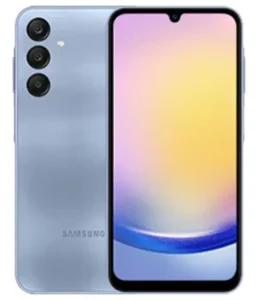
What Makes the Samsung Galaxy A25 Worth Buying?
The Samsung Galaxy A25 launched in December 2023 as one of the most feature-rich lower mid-range phones Samsung has released at this price tier — a phone that stacks 5G connectivity, a 120Hz Super AMOLED display hitting 1000 nits peak brightness, optical image stabilization on the 50MP main camera, 4K video recording, stereo speakers, and four major Android upgrade support all into a single accessible package. For buyers in the lower-to-mid budget bracket who want to check most of the modern smartphone boxes without spending significantly more, the A25 makes a compelling and well-rounded case.
The 120Hz Super AMOLED display is the first thing that sets the tone. At 6.5 inches with 1080 × 2340 pixels (~396 ppi) and 1000 nits of peak brightness, it delivers vivid AMOLED colors with fluid, smooth scrolling that 60Hz and 90Hz screens simply can’t replicate. The 120Hz refresh rate is the same specification found on many phones costing significantly more — every swipe, animation, and scroll benefits from that extra responsiveness in ways that become noticeable within minutes of picking it up. Outdoor visibility at 1000 nits HBM is strong, and the 84.2% screen-to-body ratio keeps the design modern and immersive.
5G is a meaningful differentiator at this price point. Network speed is a forward-looking consideration — buyers who plan to keep the A25 for three or more years benefit from 5G access as coverage expands in their region, maintaining faster connectivity throughout the phone’s life rather than being capped at LTE speeds as 5G becomes the prevailing standard. Combined with dual-band Wi-Fi, five-system GPS navigation, and Bluetooth 5.3, the A25’s connectivity picture is thorough and future-aware.
Camera quality is another area where the A25 punches above its weight:
- 50MP wide lens (f/1.8, OIS, PDAF, 1/2.76″): The main camera with optical image stabilization and phase-detection autofocus — OIS physically reduces hand tremor for sharper handheld stills and stabilized video, PDAF keeps subjects in sharp focus quickly.
- 8MP ultrawide (f/2.2, 120°, 1/4″): A wide-angle lens that genuinely earns its place — a 120° field of view covers group shots, landscapes, and interiors that a standard lens can’t fit without stepping back significantly.
- 2MP macro lens: Close-up photography capability for food, textures, flowers, and fine surface detail.
- 13MP front camera (f/2.2, 1/3.06″): A capable selfie shooter with a respectable sensor size and 1080p video output for video calls and social content.
4K video at 30fps on the rear camera — combined with gyro-EIS — gives the A25 genuine video credentials for this price tier. Gyro-EIS adds electronic stabilization on top of OIS, making handheld footage look noticeably smoother than unstepped-up budget video. The full gyroscope sensor also opens up AR apps, navigation orientation features, and gyroscope-dependent games that phones without this sensor can’t support.
Stereo speakers complete the media experience in a way that single-speaker budget phones cannot replicate. Sound has width and depth — watching videos, playing games, and listening to music on the A25 is a noticeably more immersive audio experience. The retained 3.5mm headphone jack keeps wired audio accessible for those who haven’t made the switch to wireless.
The Exynos 1280 on a 5nm process handles the A25’s workload comfortably — the two Cortex-A78 performance cores deliver meaningful headroom for multitasking and moderate gaming, and the 5nm process keeps thermal performance and battery efficiency in check. Four major Android upgrades from Android 14 (through Android 18) and five years of security patches extend the value proposition well beyond the typical budget phone lifespan.
Things to Know Before Choosing the Samsung Galaxy A25
The Galaxy A25 is one of the strongest value propositions in its segment, but a few realistic limitations deserve acknowledgment before purchasing. The shared SIM and microSD slot is the most practically impactful trade-off for everyday users. Expanding storage beyond the internal capacity means choosing between the second SIM slot and the microSD card — they cannot both be used simultaneously. For dual SIM users who also want storage expansion beyond the 128GB or 256GB built-in options, this is a meaningful constraint that may push them toward a phone with a dedicated third slot.
No IP water resistance rating is present on the A25. The plastic back and frame provide adequate everyday durability, but there’s no certified protection against submersion or heavy rain exposure. This is an honest trade-off that Samsung made to keep the price accessible, but buyers who frequently work or exercise outdoors in wet conditions should weigh it carefully. The Galaxy A34 addresses this gap with an IP67 rating at a moderate price premium.
A few other considerations worth noting transparently:
- Plastic back and frame: The glass front provides scratch resistance, but the rear and frame are plastic. The build is lightweight and practical, though it doesn’t convey the same material confidence as glass-back mid-range phones at higher prices.
- NFC is market-dependent: Not all regional variants of the A25 include NFC for contactless payments. Buyers who use Google Pay or similar services daily should verify their specific regional model before purchasing.
- FM radio is market-dependent: Availability varies by region — FM radio is not a guaranteed feature across all A25 variants.
- Virtual proximity sensing: A software-based solution replaces a dedicated hardware proximity sensor — occasionally less consistent during calls compared to hardware sensing.
- 25W charging on a 5000mAh battery: 25W is adequate and gets the battery refilled in a reasonable window, but faster charging competitors at similar prices now offer 33W or higher. Overnight charging is comfortable; a 30-minute quick top-up before leaving will get the battery to a useful level but not close to full.
- No Wi-Fi 6: The A25 supports Wi-Fi 5 (802.11 a/b/g/n/ac) rather than Wi-Fi 6 — a minor limitation on faster routers but unlikely to affect real-world wireless performance for most users.
Is the Samsung Galaxy A25 Right for You?
The A25 serves a broad audience well — it’s one of those rare lower mid-range phones that genuinely covers most needs without obvious compromises in the areas that matter most for daily use. Identifying the profiles it fits best helps sharpen the decision.
5G-ready budget buyers get exceptional network value from the A25. As 5G coverage expands in most markets, having 5G hardware ensures the phone stays connected at full speed throughout its lifespan rather than being LTE-capped in an increasingly 5G-dominant landscape. The four-year OS update commitment means the A25 is officially supported into the 5G era across its entire software lifespan.
Media consumers and casual gamers will find the stereo speakers and 120Hz AMOLED display deliver an above-average entertainment experience. Video content looks vibrant and sharp, audio has genuine stereo width, and the 120Hz panel makes games feel more responsive. The full gyroscope opens up games that budget phones without gyro sensors can’t properly run.
Everyday photographers who want their phone camera to handle real-world shooting situations — candid portraits, travel landscapes, handheld video — will appreciate the OIS and PDAF combination on the 50MP main lens. OIS is the specification that most directly improves everyday shot quality by compensating for the hand movement that causes soft, blurry images. The 4K rear video and gyro-EIS mean the A25 is capable of producing smooth, detailed footage for social sharing without additional equipment.
Long-term value seekers who upgrade infrequently and hold phones for three to five years get a particularly strong return on investment. Android 18 support, five years of security patches, 5G future-proofing, and the Exynos 1280’s performance headroom collectively ensure the A25 stays relevant and secure well beyond the typical budget phone lifecycle. Few phones at this price tier offer this combination of forward-looking specifications.
The A25 is a harder sell for buyers who specifically need IP water resistance — the A34 handles that — or who rely on dual SIM and storage expansion simultaneously. For those requirements, a phone with a dedicated microSD slot or a slightly higher-tier Samsung model is the appropriate choice.
Best Alternatives to the Samsung Galaxy A25
The 5G lower mid-range segment in 2024 is competitive, and a few alternatives are worth evaluating alongside the A25.
The Samsung Galaxy A34 is the most natural step up within Samsung’s lineup — adding IP67 water resistance, a 6.6-inch 120Hz Super AMOLED display (slightly larger), OIS on a 48MP main camera, and the Dimensity 1080 chipset. For buyers who want water protection and a slightly larger display, the A34 justifies its higher price. The absence of stereo speakers on the A34 is a trade-off in the other direction.
The Samsung Galaxy A35 is the A25’s direct 2024 successor — bringing a brighter display, an improved chipset, and a refined camera system. Where the A35 is available at a competitive price, it’s the stronger long-term buy for buyers who can stretch slightly.
The Google Pixel 7a competes at a nearby price in select markets and brings Google’s computational photography — widely considered among the best at its tier — along with a clean Android experience, Tensor G2 chipset, and NFC on all variants. For camera-focused buyers who prefer Google’s image processing over Samsung’s, it’s a meaningful comparison.
The Xiaomi Redmi Note 13 Pro offers a 200MP main camera, 67W fast charging, and IP54 splash resistance at a competitive price — appealing for buyers who prioritize camera resolution and faster charging speed over Samsung’s software ecosystem and update commitment.
Samsung Galaxy A25 Frequently Asked Questions
Does the Samsung Galaxy A25 support 5G?
Yes, the Samsung Galaxy A25 supports 5G connectivity alongside GSM, HSPA, and LTE. This makes it one of the more affordable Samsung phones with full 5G support at its launch price, and one of the key differentiators separating it from the Galaxy A15, which is LTE-only. 5G availability depends on the carrier and regional coverage, but the hardware is present across all A25 variants. For buyers who plan to keep their phone for several years, 5G ensures continued access to faster network speeds as coverage expands.
How many Android updates will the Galaxy A25 receive?
Samsung has committed to four major Android OS upgrades and five years of security patches for the Galaxy A25. Launched on Android 14 with One UI 7, this means the A25 is officially supported through Android 18. That represents flagship-tier software longevity applied to a lower mid-range phone — a significant long-term value advantage that most competing phones at this price tier cannot match. Buyers who hold phones for three to five years before upgrading will particularly benefit from this commitment.
Does the Galaxy A25 have optical image stabilization?
Yes, the Samsung Galaxy A25 includes optical image stabilization on its 50MP main camera. OIS is a hardware mechanism that physically compensates for camera shake during shooting — the result is sharper handheld photos, especially in lower light where slower shutter speeds amplify the effect of hand movement, and smoother video when recording while moving. The A25 also includes gyro-EIS for an additional layer of electronic stabilization during video recording. Having both OIS and gyro-EIS at this price point is uncommon and represents a genuine camera quality advantage over competitors that rely on software stabilization alone.
Can the Galaxy A25 use two SIM cards and a microSD card at the same time?
No. The Galaxy A25 uses a shared SIM and microSD slot, which means users must choose between operating two SIM cards simultaneously or using a single SIM with a microSD card for expanded storage. It is not possible to have two active SIM cards and a microSD card in the device at the same time. Buyers who need both dual SIM functionality and storage beyond the internal 128GB or 256GB capacity should factor this limitation into their decision, as it differs from older Samsung models that included a dedicated third slot.
Does the Samsung Galaxy A25 have stereo speakers?
Yes, the Samsung Galaxy A25 includes stereo speakers — a feature that appears explicitly in the confirmed specifications and represents a genuine audio advantage over budget and lower mid-range phones that ship with a single bottom-firing speaker. Stereo speakers create width and spatial depth in audio playback — watching videos, playing games, and listening to music all benefit from the directional sound separation. The A25 also retains the 3.5mm headphone jack, giving users full flexibility between wireless, wired headphone, and built-in speaker listening without needing an adapter.