
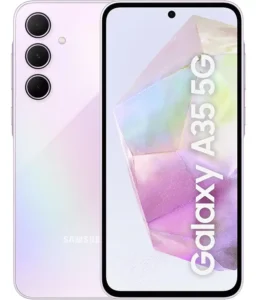
What Makes the Samsung Galaxy A35 Worth Buying?
The Samsung Galaxy A35 launched in March 2024 as a mid-range phone that genuinely earns the description. A 120Hz Super AMOLED display protected by Gorilla Glass Victus+, a 50MP main camera with both optical image stabilization and a large 1/1.96″ sensor, IP67 certified water resistance, 5G connectivity, Wi-Fi 6, and a four-major-update Android software commitment — the A35 stacks features that were once the domain of phones costing significantly more. For buyers who want a genuinely complete mid-range experience without reaching into flagship pricing, this is one of the most well-rounded options Samsung has offered at this tier.
The display sets a high standard immediately. A 6.6-inch Super AMOLED panel at 1080 × 2340 pixels (~390 ppi) running at 120Hz with 1000 nits peak brightness is excellent by mid-range standards. Gorilla Glass Victus+ on the front — a step up from the Gorilla Glass 5 found on the A34 — adds meaningful drop and scratch resistance to a panel that already delivers vivid AMOLED colors, deep blacks, and excellent outdoor visibility. The 120Hz refresh rate makes scrolling, gaming, and app navigation noticeably smoother than 60Hz or 90Hz panels — every interaction feels more immediate and polished.
The camera system is where the A35 meaningfully raises the bar compared to its predecessors and many competing mid-range phones:
- 50MP wide lens (f/1.8, OIS, PDAF, 1/1.96″): A large 1/1.96″ sensor combined with OIS and PDAF is the key differentiator — a bigger sensor captures more light, which translates directly to better low-light performance, more dynamic range in challenging lighting, and improved detail retention. PDAF ensures fast, accurate subject locking; OIS physically compensates for hand movement for sharper stills and smoother video.
- 8MP ultrawide (f/2.2, 123°, 1/4.0″): A broad 123° field of view for landscapes, architecture, group shots, and tight indoor spaces where the standard lens simply can’t fit the scene.
- 5MP macro lens: Close-up photography for textures, food, plants, and fine details at short distances.
- 13MP front camera (f/2.2, 1/3.06″): A capable selfie shooter with 4K at 30fps front video — a meaningful spec for vloggers and video callers who want the best quality from the front camera.
IP67 water resistance is one of the A35’s most practical real-world advantages. Certified to 1 meter for 30 minutes, the A35 handles rain, splashes, sweaty workouts, kitchen accidents, and accidental drops near water with genuine confidence rather than crossed fingers. This kind of protection used to be exclusively found on premium and flagship phones — the A35 brings it to a more accessible price point.
The Exynos 1380 on a 5nm process is the chipset story that powers the A35’s daily experience. Four Cortex-A78 performance cores running at 2.4 GHz deliver meaningful headroom for gaming, multitasking, and demanding apps. The Mali-G68 MP5 GPU handles graphics competently for mainstream mobile gaming titles. Available with up to 12GB RAM, the A35 multitasks cleanly and stays responsive under real workloads. Wi-Fi 6 — rather than the Wi-Fi 5 found on many competing phones — ensures the A35 benefits from faster, more efficient wireless connections on compatible routers now and into the future.
The software commitment is flagship-tier applied to a mid-range phone. Android 14 at launch with four major OS upgrades — officially through Android 18 — and five years of security patches means the A35 stays current and protected well into 2029. Combined with the Exynos 1380’s performance headroom, this phone is designed for extended ownership rather than rapid planned obsolescence. eSIM support alongside physical Nano-SIM adds modern flexibility for travelers and users who switch carriers without physically swapping cards.
Things to Know Before Choosing the Samsung Galaxy A35
The Galaxy A35 is a strong all-around mid-range phone, but a few trade-offs are worth understanding honestly before buying. The removal of the 3.5mm headphone jack is the most noticeable practical change from older A-series models and the Galaxy A25. The A35 is USB Type-C audio or wireless only — buyers who use wired headphones daily will need USB-C headphones or a USB-C to 3.5mm adapter. Given how many mid-range phones have made this transition, it’s less surprising than it once was, but it’s a genuine daily-use adjustment for affected buyers.
The shared SIM and microSD slot creates the same trade-off found on many recent Samsung models. Expanding storage beyond the internal capacity — whether 128GB or 256GB — requires giving up the second SIM slot. Running dual SIM and microSD simultaneously is not possible. For buyers who rely on two active SIM cards for work and personal use and also need additional storage, this requires either choosing a higher internal storage tier or finding a phone with a dedicated third slot.
Several other points deserve transparent mention:
- Glass back raises stakes without IP68: The glass back is a premium build improvement over plastic alternatives, but IP67 — rated to 1 meter for 30 minutes — is not the deeper IP68 found on flagship phones. The A35 handles everyday moisture exposure confidently; prolonged submersion or pressurized water is not covered.
- NFC is market-dependent: Not all regional A35 variants include NFC for contactless payments. Buyers who rely on Google Pay or similar services should confirm their specific market model before purchasing.
- Virtual proximity sensing: A software-based solution handles proximity detection rather than a dedicated hardware sensor — occasionally less reliable during calls than physical hardware proximity sensing.
- 25W charging on a 5000mAh battery: 25W is adequate for overnight charging and workable for top-ups, but competing phones at similar prices increasingly offer 33W, 45W, or faster. The charging speed is functional rather than fast.
- No FM radio: FM radio is confirmed absent on the A35 — a small but real loss for users who used it on older Samsung A-series models for commuting or areas with limited data coverage.
- 209g weight: At 209g, the A35 is noticeably heavier than lighter mid-range alternatives. For extended one-hand use or buyers who prefer lighter phones, the weight is worth factoring in.
Is the Samsung Galaxy A35 Right for You?
The A35 is designed for buyers who want a genuinely complete mid-range experience — one that doesn’t require a mental list of compromises for daily use. Understanding which specific profiles it serves best makes the decision cleaner.
Active and outdoor users will find the IP67 rating meaningful every day. Whether commuting in rain, working out at the gym, cooking with wet hands, or spending time near water on weekends, the A35’s certified water resistance removes anxiety that plastic-bodied, unrated alternatives carry. Combined with Gorilla Glass Victus+ on both front and back, the A35 is built to handle real-world wear in ways that most phones at this price tier simply aren’t.
Photography enthusiasts on a mid-range budget get a genuinely capable imaging package. The 1/1.96″ main sensor is meaningfully larger than the sensors in most competing mid-range cameras — a larger sensor equals more light capture, which translates to better dynamic range, richer colors, and less noise in challenging lighting conditions like indoor events, golden hour, or overcast outdoor scenes. OIS and PDAF together ensure the camera keeps up with moving subjects and handheld shooting without requiring extra effort from the user. 4K video from both the front and rear cameras is a feature that many competing phones at this price don’t offer.
5G users and future-proofers get strong long-term value. 5G connectivity, Wi-Fi 6, Bluetooth 5.3, five-satellite GPS, and four major Android upgrades collectively ensure the A35 stays technically relevant for years. Buyers who hold phones for three to four years before upgrading will particularly benefit from this forward-looking specification package.
Students and everyday professionals who use their phone heavily for communication, social media, streaming, and productivity will find the 120Hz AMOLED display makes everything feel better, the Exynos 1380 handles multitasking smoothly, and the 5000mAh battery carries through demanding days without stress. Stereo speakers make lunch-break video watching genuinely enjoyable without headphones. The under-display optical fingerprint sensor provides fast, natural biometric access.
The A35 is a harder case for buyers who use wired headphones daily and don’t want to adapt, need simultaneous dual SIM and expanded storage, or want IP68 deep-water protection. For the fullest flagship-tier protection and features, Samsung’s Galaxy S-series addresses those requirements.
Best Alternatives to the Samsung Galaxy A35
The 5G mid-range market in 2024 is genuinely competitive, and a few alternatives merit direct comparison alongside the A35.
The Samsung Galaxy A54 — the A35’s predecessor in Samsung’s lineup — remains available and offers a nearly identical feature set with the Exynos 1380, IP67, OIS, and four OS updates. Where the A54 is available at a discounted price, it’s worth comparing directly since the specifications overlap significantly.
The Google Pixel 8a competes at a nearby price point in select markets and brings Google’s computational photography — widely regarded as among the best available — with the Tensor G3 chipset, IP67, and seven years of OS updates. For buyers who prioritize camera quality and software longevity above all else and prefer Google’s clean Android experience, the Pixel 8a is a serious competitor.
The Xiaomi Redmi Note 13 Pro+ targets performance and charging speed with 120W fast charging — dramatically faster than the A35’s 25W — alongside a 200MP main sensor and IP68 water resistance. For buyers where those specific specifications are priorities, it’s a compelling alternative.
The Nothing Phone (2a) entered 2024 at a competitive price with the Dimensity 7200 Pro chipset, a 50MP dual-camera system, and a distinctive translucent design. For buyers who want strong performance and a unique aesthetic at the A35’s price tier, it’s worth considering — though its IP rating and software update commitment differ from Samsung’s.
Samsung Galaxy A35 Frequently Asked Questions
Is the Samsung Galaxy A35 waterproof?
The Samsung Galaxy A35 carries an IP67 rating, certifying dust resistance and water immersion protection to 1 meter for up to 30 minutes. This covers rain, splashes, kitchen accidents, and accidental drops in shallow water confidently. IP67 differs from IP68, which certifies deeper submersion — the A35 should not be used for underwater photography or submerged in pools. For real-world everyday protection against the common moisture situations most users encounter, IP67 is highly effective and represents meaningful protection at this price tier.
How many Android updates does the Galaxy A35 support?
Samsung has committed to four major Android OS upgrades and five years of security patches for the Galaxy A35. Launched on Android 14 with One UI 7, this means the A35 is officially supported through Android 18 — keeping the phone current with major OS features and protected from security vulnerabilities through approximately 2029. This is a flagship-level software commitment applied to a mid-range phone and one of the strongest long-term value arguments for the A35 over competing phones that typically offer two or three updates at this price.
What makes the Galaxy A35 camera better than previous A-series models?
The most meaningful upgrade in the A35’s camera over predecessors like the A34 is the main sensor size — 1/1.96″ compared to smaller sensors in previous models. A larger sensor captures significantly more light per pixel, which improves low-light performance, dynamic range, and color accuracy in challenging lighting without relying entirely on software processing. OIS and PDAF remain present for stabilized, sharp images. The front camera also supports 4K video at 30fps — not available on all previous A-series models — which is valuable for high-quality selfie video content. The combination of sensor size, OIS, and 4K front video makes the A35’s camera system a meaningful step up in real-world versatility.
Does the Samsung Galaxy A35 have Wi-Fi 6?
Yes, the Samsung Galaxy A35 supports Wi-Fi 6 (802.11 a/b/g/n/ac/6) alongside dual-band operation and Wi-Fi Direct. Wi-Fi 6 provides faster throughput, better performance in crowded network environments with multiple connected devices, and improved power efficiency compared to Wi-Fi 5. In everyday home or office use on a compatible Wi-Fi 6 router, this translates to faster wireless speeds and more stable connections during streaming, video calls, or large file downloads. Wi-Fi 6 support is notably absent on several competing phones at the A35’s price tier, making it a forward-looking connectivity advantage.
Does the Galaxy A35 have NFC for contactless payments?
NFC availability on the Samsung Galaxy A35 varies by market and regional variant. Some versions include NFC for contactless payments via services like Google Pay and quick device pairing, while others do not. Buyers who rely on NFC for daily payment transactions should verify whether their specific regional model includes NFC before purchasing. This information is typically available on the retail listing or Samsung’s local product page. The A35 also supports eSIM alongside physical Nano-SIM — a modern connectivity option that allows digital carrier switching without physical card swapping.